

BLOG

Ambrosia: Coconut production in species-rich agroforestry systems
Daniel Dalet, the president of the operator company 12Tree Organics and manager of the Ambrosia farm in Nagua, Dominican Republic is a specialist in coconut farming and processing with more than 12 years of experience. We had the chance to ask him some questions regarding his passion for sustainable agriculture and coconut production as well as challenges they tackle on the farm.

Daniel, please tell us, why coconuts? What makes them special?
Coconut palms are beautiful crops with many different uses. This is what makes them so special, a simple plant meets many different consumer needs at the same time. From lifestyle products, to food, to industrial fibers. Another important advantage, in my opinion, is that the management of the coconut palm is comparatively simple. It is very resistant to extreme weather events, such as hurricanes. If continuous irrigation is provided and nutrients are supplied regularly, the coconut palm is very resilient.
Besides, coconuts present a very good business opportunity. The coconut market is severely underserved. It grows by rates of more than 10% every year whereas the supply rises just by 2%. This results in a huge potential for planted coconuts. And additionally, as a sustainable entrepreneur, I’m driven by impact. Not only social but environmental impact. We plant the coconut palms in regenerative agroforesty systems, which continuously improve the soil, the overall biodiversity and provides permanent jobs for many people in the regions. Such systems are more resilient to tackle the future challenges arising from climate change. Looking at the problems we have created through conventional agriculture, I see a future for sustainably grown coconut palms.

Daniel Dalet, president of 12Tree Organics
“Research has shown that the soil is alive. Therefore, we have to treat it like a living organism. Through conventional agriculture, we continue to destroy it, and this disrupts the entire carbon cycle of the planet. Climate change is the direct consequence of this and thus the big problem of how to feed the growing world population with ever poorer harvests.” - Daniel Dalet
That brings me directly to my next question: How are coconuts grown at the Ambrosia farm?
Coconuts are the main cash crop on the farm. They are the central element of all our plots. After an initial growing period in our nursery, the young seedlings are planted in an eight-by-eight triangle. In between they are intercropped with cacao or plantain, while the rest is covered with a dense green groundcover, also known as cover crops. Coconuts are the perfect element for such diverse systems, since they don’t take a lot of space due to their height, while they enrich the soil and act as shading elements within the system.
The coconut palms on our farm have a lifespan of about 15 years, after which we replant, otherwise they are too large for harvesting. Generally, harvesting coconut palms is not easy, so we have specially trained field workers. After harvesting, we remove the husk of the coconut, which is the soft fibrous shell. We granulate this into a powder, which we spread as organic fertilizer on all our fields. The coconut shell with the valuable copra is sold on the market to processors as well as exporters.

Agroforestry farming system at Ambrosia
Why do you think the market is still so undersupplied with coconuts, although demand is constantly increasing, and cultivation should therefore be very profitable?
I see the biggest hurdle in coconut production at the very beginning of the investment. The initial investment is high because you have to invest time and inputs in the crop for six years to get a productive coconut palm. In addition, everything depends on genetics. It is not easy to get highquality seeds, and that makes largescale investments even more difficult and risky. Only when the coconut palm bears fruits – you can tell if the quality of the seed were good or bad, so only after 5-6 years of cultivation. Therefore, you need experienced people on board if you want to get into this business. Also, you need a lot of space, flat land and continuous water supply to grow coconut palms properly. But if all these conditions are in place, if you have the land, the money and the right management, you can make it profitable through sustainability.
This article is an extract of the 2022 12Tree Sustainability Report

A new take on large-scale agroforestry systems in cocoa
A fresh look into agroforestry in an era of climate change, severe droughts and reducing cocoa yields.
As we know, cocoa trees are native to the tropical rain forest from Southern Mexico to South America. However, cocoa’s natural environment favors fungal diseases, which decrease the plant’s productivity. That’s why, farmers looked for drier climates to set up new cocoa plantations. These new climatic conditions brought new challenges: water availability, organic matter in soil, adequate nutrition programs, etc.
For most South American producers, the solution was clear: establish monoculture cocoa plantations in dry climates with irrigation systems that supply the water demand and compensate the evapo-transpiration rates in such conditions. However, with climate change, these dry zone plantations may have less water available over time. As rainfall decreases and temperature increases, deeper wells and bigger water reservoirs will be needed. These factors combined with a volatile market has made agriculture-oriented companies, such as 12Tree, to take a look at agroforestry with new eyes.

Cacao planted in association with rubber and Brachiaria ruziziensis as cover crop in Chimelb Farm
Contrary to the old days with small holders that used different levels of canopies and crops in an agroforestry system, current agroforestry in cocoa provides moderate shade, while maintaining the environmental services of a traditional agroforestry plantation, like protection to the younger plants from radiation and extreme heat, reduced evapo-transpiration rate, increase organic matter in the soil over time, and so on. By reducing evapo-transpiration (evaporation from the soil and transpiration from the plants stomatas), the amount of water required by the main crop reduces significantly. A cocoa plantation in a full exposure system, for example, will require a higher water lamina than an agroforestry plantation, just because of the reduction in evapo-transpiration. Lower water requirements mean smaller investment in pumps, wells and reservoirs, and less energy consumption because of shorter irrigation turns. In other words, lower operation costs.

Species like the Alouatta palliata, present in the Cuango Farm, could use the farm as a biological corridor between natural forests inside the farm
Soil cover is another example of a way to reduce evaporation from the soil and recycle nutrients. Such is the case of 12Tree’s “Chimelb” Farm, where Brachiaria ruziziensisis used as a soil cover in association with cacao.
Using leguminous plants as primary shade, can also result in a decrease in the amount of nutrients that must be provided to the plantation, as leguminous help fixing nitrogen in the soil. The presence of shade decreases the amount of weed in the plantation, decreasing the cost of weeding in the operation, which ensures the fertilization is more effective as there is less competition between the actual crop and weed for nutrients. An example is the use of pigeon peas as preliminary shade in a 548ha plantation in the Caribbean in Panama. Pigeon peas are consumed traditionally in the country, so a market is guaranteed, and the cocoa is developing better than with other types of shade. In 12Tree’s “Cuango” Farm, we are using pigeon peas as primary shade to help fix nitrogen and Gliricidia sepium (madre cacao) as a mid-term nitrogen fixing shade plant.

Use of plantain of the Musaceae family as primary shade in Cuango Farm
By using profitable shade crops, the same plot of land can be used to produced two or more different crops that are linked to different markets which increase the economic resilience of a project.
Using Musaceae in the earlier stages of a cocoa plantation, for example, brings a positive impact to a project’s returns. Bananas and plantains usually are consumed internally in the cocoa producing countries, this means there is a local market for the crops and an earlier return to the plantation. Musaceae also attract Forcipomyia, a pollinator of cocoa. Having this pollinator in the plantation increases the pod production, thus increasing the returns.
Permanent profitable shade crops provide permanent additional revenues to the plantations over time. As is the case of the “Ambrosia” Farm, where cacao is combined with coconut.
Agroforestry systems are known to increase a plantation’s environmental resilience, but they can also increase the economic resilience. To convince investors and producers about the importance of agroforestry, it becomes necessary to combine both environmental and economic benefits of properly designed and managed agroforestry systems.
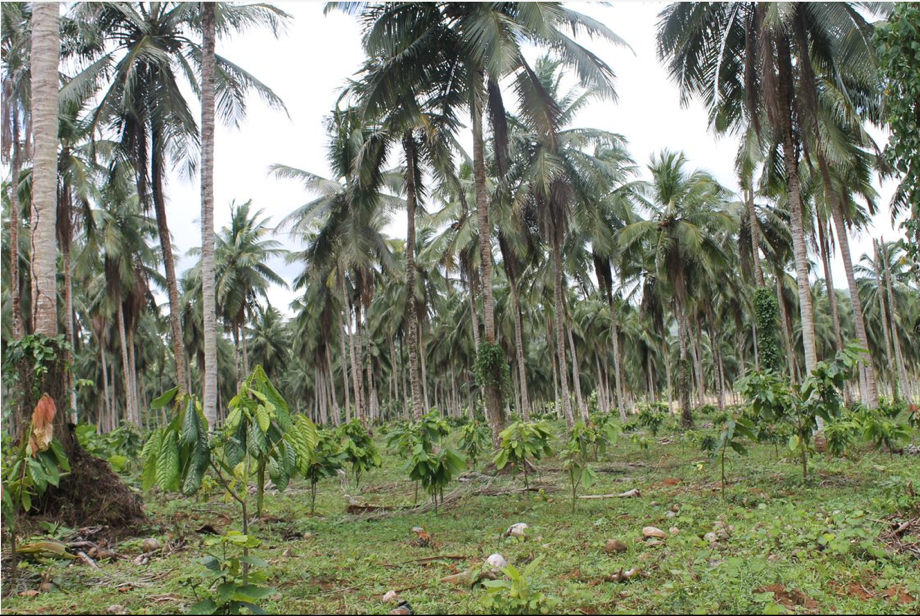
Young plantlets growing under moderate profitable shade of coconut in Ambrosia Farm