

BLOG
How German pension funds are investing significantly in sustainable agroforestry: Interview with Richard Focken, CEO of 12Tree

In this episode of Investing in Regenerative Agriculture and Food podcast, Richard Focken, co-founder and current CEO of 12Tree, talks about 12Tree’s theory of change, investing in agroforestry, barriers for institutional investors, communication with investors, returns in agroforestry, and much more!

Sustainability as a pre-requisite for business
Why there is a need for a production that reconciles investors, environment and people: it is all linked; sustainability is a pre-requisite of our business.
12TREE has dedicated itself to redefining the way how agriculture and forestry is practiced. We invest in ecosystems that are most vulnerable, such as the tropics and arid areas, where deforestation and desertification are pressing issues. We see a need to bring innovation and sustainable agroforestry practices to a sector that still relies on millions of small farmers who are trapped in poverty and are barely participating in the value creation from what they grow on their fields.
Our inclusive approach combines developing large-scale modern sustainable agroforestry projects that create hundreds of secure jobs in poor rural areas in the production of certified premium products such as cocoa, coffee, bananas, coconuts, timber and much else and enabling the nearby small producers to participate in global markets as they can sell their crops with improved quality that is rewarded with fair prices. This has a direct positive impact on their livelihoods and gives them and their families a future in farming.

As a specialized asset manager with a strong ESG focus who is operating projects in many countries in Latin America and Africa we experience first-hand the negative impact that changing weather patterns have on the everyday life of farmers. More severe droughts and desertification are a reality today and not a theoretical discussion about the future of our planet. Intensive agriculture and rapidly progressing deforestation of precious forests have devastating consequences for entire ecosystems and destroy the last habitats for many animal species.
Our approach makes investments in sustainable agroforestry scalable for large institutional investors who are seeking ways to deploy capital in real assets with high social and environmental impact, good governance and attractive stable returns.
We believe that sustainable land management practices and socially responsible employment in high-productivity farming are the future and not a conflict. Sustainable management really is a necessity for successful long-term investments as it mitigates operational risks and ensures that the ever-increasing global demand for certified, fairly-traded and traceable products can be satisfied.

12TREE now is investing into reforestation and the development of new sustainable agroforests – the intelligent combination of agriculture and forestry that is proven to be much more biodiverse and resilient than conventional agriculture happening in monoculture plantations. We are not only experienced investment managers but also have strong local teams of seasoned experts with a broad range of technical expertise who supervise our projects and continuously strive to improve all project dimensions.
If you haven’t heard of us before is because we have been very busy. With more than 20.000 hectares of agroforests in 7 countries that we have established we may become the largest sustainable cocoa producer in the world in the next few years. That puts us in a position to really change the way things are traditionally done in this industry. We negotiate directly with large buyers who are looking for partners that can provide them with large volumes of sustainable production. We can invest fast and immediately change poor working conditions and destructive practices such as pollution and slash-and-burn practices. We think in value chains and landscapes, which means we employ regionally, we buy regionally, and we produce regionally to make sure that the region profits most from our investment.

A new take on large-scale agroforestry systems in cocoa
A fresh look into agroforestry in an era of climate change, severe droughts and reducing cocoa yields.
As we know, cocoa trees are native to the tropical rain forest from Southern Mexico to South America. However, cocoa’s natural environment favors fungal diseases, which decrease the plant’s productivity. That’s why, farmers looked for drier climates to set up new cocoa plantations. These new climatic conditions brought new challenges: water availability, organic matter in soil, adequate nutrition programs, etc.
For most South American producers, the solution was clear: establish monoculture cocoa plantations in dry climates with irrigation systems that supply the water demand and compensate the evapo-transpiration rates in such conditions. However, with climate change, these dry zone plantations may have less water available over time. As rainfall decreases and temperature increases, deeper wells and bigger water reservoirs will be needed. These factors combined with a volatile market has made agriculture-oriented companies, such as 12Tree, to take a look at agroforestry with new eyes.

Cacao planted in association with rubber and Brachiaria ruziziensis as cover crop in Chimelb Farm
Contrary to the old days with small holders that used different levels of canopies and crops in an agroforestry system, current agroforestry in cocoa provides moderate shade, while maintaining the environmental services of a traditional agroforestry plantation, like protection to the younger plants from radiation and extreme heat, reduced evapo-transpiration rate, increase organic matter in the soil over time, and so on. By reducing evapo-transpiration (evaporation from the soil and transpiration from the plants stomatas), the amount of water required by the main crop reduces significantly. A cocoa plantation in a full exposure system, for example, will require a higher water lamina than an agroforestry plantation, just because of the reduction in evapo-transpiration. Lower water requirements mean smaller investment in pumps, wells and reservoirs, and less energy consumption because of shorter irrigation turns. In other words, lower operation costs.

Species like the Alouatta palliata, present in the Cuango Farm, could use the farm as a biological corridor between natural forests inside the farm
Soil cover is another example of a way to reduce evaporation from the soil and recycle nutrients. Such is the case of 12Tree’s “Chimelb” Farm, where Brachiaria ruziziensisis used as a soil cover in association with cacao.
Using leguminous plants as primary shade, can also result in a decrease in the amount of nutrients that must be provided to the plantation, as leguminous help fixing nitrogen in the soil. The presence of shade decreases the amount of weed in the plantation, decreasing the cost of weeding in the operation, which ensures the fertilization is more effective as there is less competition between the actual crop and weed for nutrients. An example is the use of pigeon peas as preliminary shade in a 548ha plantation in the Caribbean in Panama. Pigeon peas are consumed traditionally in the country, so a market is guaranteed, and the cocoa is developing better than with other types of shade. In 12Tree’s “Cuango” Farm, we are using pigeon peas as primary shade to help fix nitrogen and Gliricidia sepium (madre cacao) as a mid-term nitrogen fixing shade plant.

Use of plantain of the Musaceae family as primary shade in Cuango Farm
By using profitable shade crops, the same plot of land can be used to produced two or more different crops that are linked to different markets which increase the economic resilience of a project.
Using Musaceae in the earlier stages of a cocoa plantation, for example, brings a positive impact to a project’s returns. Bananas and plantains usually are consumed internally in the cocoa producing countries, this means there is a local market for the crops and an earlier return to the plantation. Musaceae also attract Forcipomyia, a pollinator of cocoa. Having this pollinator in the plantation increases the pod production, thus increasing the returns.
Permanent profitable shade crops provide permanent additional revenues to the plantations over time. As is the case of the “Ambrosia” Farm, where cacao is combined with coconut.
Agroforestry systems are known to increase a plantation’s environmental resilience, but they can also increase the economic resilience. To convince investors and producers about the importance of agroforestry, it becomes necessary to combine both environmental and economic benefits of properly designed and managed agroforestry systems.
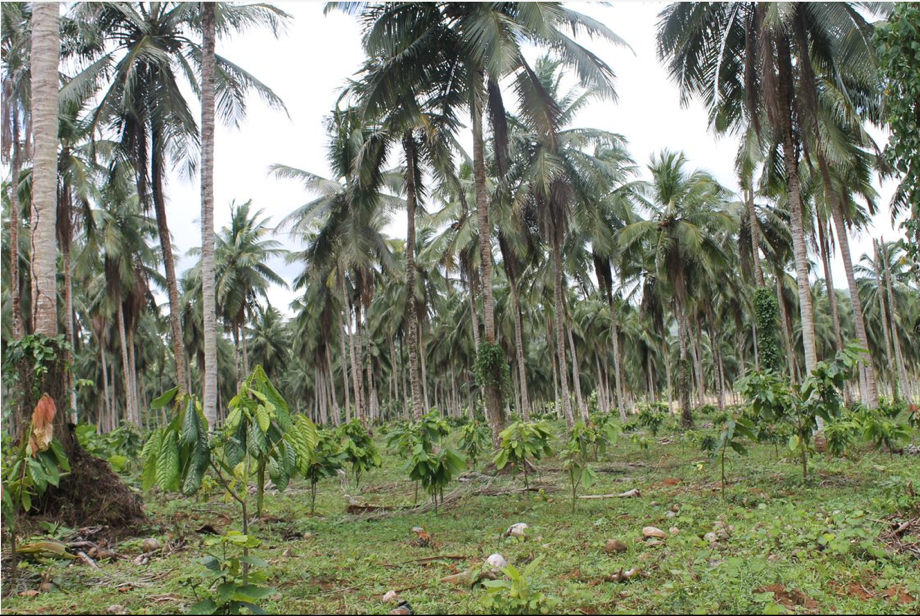
Young plantlets growing under moderate profitable shade of coconut in Ambrosia Farm