

BLOG

Andean Cacao: Mars Wrigley’s mission for a climate-neutral cocoa bean
In 2021, Mars Wrigley announced a joint climate-smart venture, Andean Cacao, with 12Tree and ECOM, one of the world’s largest suppliers of sustainable cacao beans.

Andean Cacao’s vision is to catalyze an industry shift, transforming formerly degraded land into a scalable, sustainable production model. The initial target for the venture is to regenerate 2,000+ hectares of pastureland in Colombia. We had the honor of interviewing Matthew Moudy, who leads Mars Wrigley’s Modern Sustainable Cocoa Farming strategy. He leads the initiative on Mars Wrigley’s side and works closely with the Andean Cacao team on a weekly basis. During the interview, we talked about the company’s overall sustainability strategy as well as their perspective and motivation to support Andean Cacao.
How does Mars Wrigley define sustainable cacao production?
The way cacao beans are produced today holds many challenges for us humans as well as nature. We aim to reshape the future of cacao by creating an inclusive, modern and sustainable supply chain. This means creating a cacao sector where human rights are respected, the environment is protected and everyone, especially cacao farmers, has the opportunity to thrive. It is still a fact that farmers, especially smallholders, are the most challenged actor in the food supply chain. They bear all the production risk, but often do not earn enough to provide a decent income. We want to ensure that supply chains are built in a way that allows people to thrive. And this goes beyond ensuring proper incomes and premiums, but also by supporting them to increase their productivity, and developing alternative large-scale farm models where farming communities can find decent job opportunities and wages. For us, protecting the planet goes far beyond meeting the bare minimum, such as no water and air pollution. It’s about reducing carbon footprint and stopping deforestation in our supply chain. Mars is a member of the World Cocoa Foundation’s Cocoa & Forests Initiative and a signatory to the CFI commitments to halt deforestation and restore forests in the global cacao supply chain. Our aim is to achieve a deforestation-free supply chain by 2025 and to further achieve carbon neutrality by 2050.
And how does Andean Cacao fit into this strategy?

Farm visit with Andean Cacao
Andean Cacao is our flagship project, in which we want to catalyze an industry shift, to prove how climate-smart cacao production can work at a large-scale. We made some big bets, transforming the cacao sector sustainably towards carbon neutrality, thriving farmers and all involved stakeholders of our supply chain… With Andean Cacao we can prove that such a transition is possible. The project is still in the transformation process, regenerating formerly degraded cattle grazing land into a highly productive, sustainable farm with the goal of delivering quality carbon-neutral cacao beans. The project seeks to improve carbon sequestration, soil health, and biodiversity, create living-wage job opportunities, and support neighbor communities. Another important aspect here is our land footprint. As our business continues to grow, we faced the question of how we ensure that we are not using land for cacao production that local people need to grow food in order to survive. Therefore, we made the commitment not to take up any more land in the supply chain. As part of Mars journey to become Net Zero by 2050, we have committed to have no greater land footprint in 2050 than we had in 2015 and foster smart-ag, regenerative and resilient practices in place within our supply chain. In order to achieve this, we need to be more productive on the land we already have - once again this is where Andean Cacao comes in.
What impresses you most about the project?
Every day we learn something new. What I really admire about Andean Cacao CEO Xavier Sagnieres and his team is that they are proactive instead of reactive. Each new insight is taken in and serves as the basis for the next decision or strategy adjustments. As a result, the project does not stop but gets better each year. The scale we are at today is tiny in comparison where we will be, so being able to make these learnings is super important. And second, Andean Cacao is showing that it works, that climate smart agriculture enables high productivity while continuously improving the health and well-being of the environment, the soil, and the people.
12Tree is proud to be a partner of the CIAT initiative “CLIMA-LoCa”.

Harvest specialist Carlos Escobar, Cesar Botero (CIAT counterpart) and local staff at Maquencal.
The CIAT project CLIMA LoCa stands for fostering Climate-relevant and Low Cadmium innovations as well as research to enhance the inclusiveness of growing cocoa sectors in Colombia, Ecuador and Peru.
Cadmium is a chemical substance that is harmful to kidneys and can increase the risk of cancer. Since cadmium can be found naturally in soil because of volcanic activity, forest fires and weathering of rocks its presence in cocoa beans depends on many factors, including geographic location, the soil acidity and cocoa variety used. Plants such as cacao can absorb und accumulate cadmium from water in the soil. The chemical is stored in the leaves and seeds of the cacao tree that will be processed into chocolate bars or cocoa drinks. Even though the cadmium levels in processed chocolate on the market is relatively low, eating too much chocolate may increase the amount of cadmium in your body.

The first sampling of a total of eight sampling efforts that will take place in the following 4 years.
In order to protect consumers, the European Union (EU) published a new food safety regulation for cadmium in cacao. However, the new regulations strongly impact low-income producers, especially in rural zones.
The EU-funded Clima-LoCa project is conducting cadmium and climate adaption research to support the development, implementation and scaling of low cadmium and climate-relevant innovations that fit the diverse contexts of smallholder cocoa production.
Since climate change and high levels of cadmium in the cacao beans are critical challenges for smallholder farmers to access the European markets and better prices, the research is a major step towards integrating small farmers into the global value chain of the cocoa industry.
The Clima-LoCa project is financed by the European Commission initiative “Development Smart Innovation through Research in Agriculture” (DeSIRA) and led by the Alliance of Bioversity International and CIAT.

A new take on large-scale agroforestry systems in cocoa
A fresh look into agroforestry in an era of climate change, severe droughts and reducing cocoa yields.
As we know, cocoa trees are native to the tropical rain forest from Southern Mexico to South America. However, cocoa’s natural environment favors fungal diseases, which decrease the plant’s productivity. That’s why, farmers looked for drier climates to set up new cocoa plantations. These new climatic conditions brought new challenges: water availability, organic matter in soil, adequate nutrition programs, etc.
For most South American producers, the solution was clear: establish monoculture cocoa plantations in dry climates with irrigation systems that supply the water demand and compensate the evapo-transpiration rates in such conditions. However, with climate change, these dry zone plantations may have less water available over time. As rainfall decreases and temperature increases, deeper wells and bigger water reservoirs will be needed. These factors combined with a volatile market has made agriculture-oriented companies, such as 12Tree, to take a look at agroforestry with new eyes.

Cacao planted in association with rubber and Brachiaria ruziziensis as cover crop in Chimelb Farm
Contrary to the old days with small holders that used different levels of canopies and crops in an agroforestry system, current agroforestry in cocoa provides moderate shade, while maintaining the environmental services of a traditional agroforestry plantation, like protection to the younger plants from radiation and extreme heat, reduced evapo-transpiration rate, increase organic matter in the soil over time, and so on. By reducing evapo-transpiration (evaporation from the soil and transpiration from the plants stomatas), the amount of water required by the main crop reduces significantly. A cocoa plantation in a full exposure system, for example, will require a higher water lamina than an agroforestry plantation, just because of the reduction in evapo-transpiration. Lower water requirements mean smaller investment in pumps, wells and reservoirs, and less energy consumption because of shorter irrigation turns. In other words, lower operation costs.

Species like the Alouatta palliata, present in the Cuango Farm, could use the farm as a biological corridor between natural forests inside the farm
Soil cover is another example of a way to reduce evaporation from the soil and recycle nutrients. Such is the case of 12Tree’s “Chimelb” Farm, where Brachiaria ruziziensisis used as a soil cover in association with cacao.
Using leguminous plants as primary shade, can also result in a decrease in the amount of nutrients that must be provided to the plantation, as leguminous help fixing nitrogen in the soil. The presence of shade decreases the amount of weed in the plantation, decreasing the cost of weeding in the operation, which ensures the fertilization is more effective as there is less competition between the actual crop and weed for nutrients. An example is the use of pigeon peas as preliminary shade in a 548ha plantation in the Caribbean in Panama. Pigeon peas are consumed traditionally in the country, so a market is guaranteed, and the cocoa is developing better than with other types of shade. In 12Tree’s “Cuango” Farm, we are using pigeon peas as primary shade to help fix nitrogen and Gliricidia sepium (madre cacao) as a mid-term nitrogen fixing shade plant.

Use of plantain of the Musaceae family as primary shade in Cuango Farm
By using profitable shade crops, the same plot of land can be used to produced two or more different crops that are linked to different markets which increase the economic resilience of a project.
Using Musaceae in the earlier stages of a cocoa plantation, for example, brings a positive impact to a project’s returns. Bananas and plantains usually are consumed internally in the cocoa producing countries, this means there is a local market for the crops and an earlier return to the plantation. Musaceae also attract Forcipomyia, a pollinator of cocoa. Having this pollinator in the plantation increases the pod production, thus increasing the returns.
Permanent profitable shade crops provide permanent additional revenues to the plantations over time. As is the case of the “Ambrosia” Farm, where cacao is combined with coconut.
Agroforestry systems are known to increase a plantation’s environmental resilience, but they can also increase the economic resilience. To convince investors and producers about the importance of agroforestry, it becomes necessary to combine both environmental and economic benefits of properly designed and managed agroforestry systems.
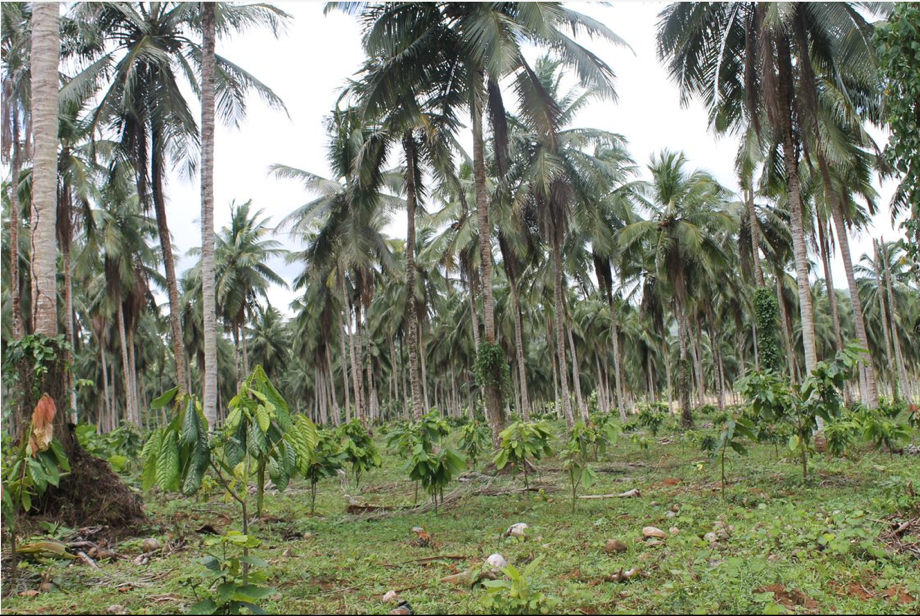
Young plantlets growing under moderate profitable shade of coconut in Ambrosia Farm